
This article is general information, not medical advice. Talk to your midwife or doctor before changing your diet in late pregnancy, especially if you have gestational diabetes.
The tradition of dates in late pregnancy
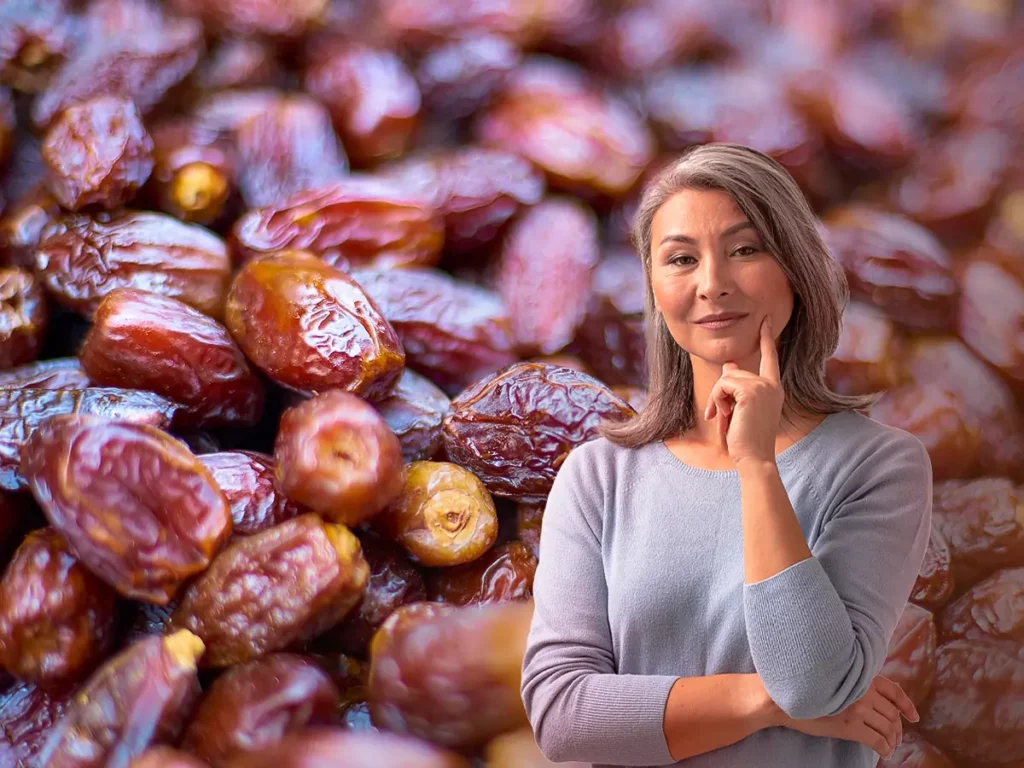
The date fruit (Phoenix dactylifera) has been an everyday food across the Middle East and North Africa for a very long time, and in many families women are told to eat dates in the last weeks of pregnancy. The usual reasons given are that dates prepare the body for labor and help the birth go more easily. Those beliefs come from tradition. Since 2011 a number of clinical studies have tested them, so it is now possible to say what has been measured and how good that evidence is.
Dates are a whole food with a lot of natural sugar, some fibre, and useful amounts of potassium and magnesium (see the nutrition figures below). Many women hope a few dates a day might mean less chance of induction or a shorter labor. This article looks at the explanations people give for an effect, then at what the trials actually found, and then at the practical side: how many dates the studies used and who should be careful. If you are buying dates for the last weeks of pregnancy, our page on date supplier quality and freshness covers how to pick fresh stock.

Proposed explanations, and what is actually known
Articles about dates and labor often describe how dates are supposed to work. These explanations are ideas, not findings. None of the trials discussed below measured hormones or receptors in the women who ate dates. They measured outcomes such as cervical dilation and the need for induction.
1. The oxytocin receptor idea
Oxytocin is the hormone that drives uterine contractions. One suggestion is that fatty acids in dates make the uterus more responsive to the body's own oxytocin. We found no study in pregnant women that shows this happens, so treat it as a hypothesis.
2. Serotonin and prostaglandins
Prostaglandins help soften and open the cervix before labor, and some writers suggest dates support their production, or that tryptophan in dates feeds into serotonin and uterine contraction. We could not find a study in pregnant women that tested either idea. The cervical changes reported in the date trials are real measurements, but how dates might cause them is unknown.
3. Energy
Dates are mostly sugar. Per 100 g, USDA lists 75 g of carbohydrate and 63 to 67 g of total sugars, about 277 kcal for Medjool and 282 kcal for Deglet Noor. A small study found a low glycaemic index (about 44 to 55) for five date varieties in healthy and type 2 diabetic adults (Alkaabi 2011). That makes dates an easy snack in late pregnancy. No study has shown that this energy prevents complications in labor.
Dates have 6.7 to 8 g of fibre per 100 g (USDA). Constipation is common in pregnancy, and the NHS suggests eating foods high in fibre, including fruit, to help prevent it.
4. Potassium and magnesium
Per 100 g, dates have 656 to 696 mg of potassium and 43 to 54 mg of magnesium (USDA). The NHS says potassium helps control the balance of fluids in the body and helps the heart muscle work properly, and that adults need 3,500 mg a day. There is no evidence that the potassium or magnesium in dates changes how the uterus contracts in labor.
The clinical evidence: what the studies show
Most of the research looks at three things: how ready the cervix is when labor starts, whether women need induction, and how long labor lasts. A 2024 review counted 48 studies, both randomised and non-randomised (Salajegheh 2024).
The first widely cited study (2011)
The study most often quoted was carried out in Jordan and published in the Journal of Obstetrics and Gynaecology (Al-Kuran 2011). 69 women ate six dates a day for the 4 weeks before their due date and were compared with 45 women who ate none. Compared with the women who ate no dates, the date group had:
- more cervical dilation on admission to hospital: 3.52 cm against 2.02 cm
- intact membranes more often on arrival: 83% against 60%
- spontaneous labor more often: 96% against 79%
- less use of prostin or oxytocin to induce or speed up labor: 28% against 47%
- a shorter latent phase of the first stage: 510 minutes against 906 minutes
The delivery outcome was more favourable in the date group but the difference was not statistically significant. It was not randomised, and the authors said a randomised controlled trial was needed. It is a promising first result, not proof.

Later studies and the 2024 meta-analysis
Other groups have since run their own trials, and the results vary from study to study. The largest pooled analysis so far is the 2024 systematic review and meta-analysis in BMC Pregnancy and Childbirth (Salajegheh 2024).
Pooling the studies, the review found that eating dates in late pregnancy was linked with:
- a higher Bishop score (a measure of how ready the cervix is for labor) and more cervical dilation on admission
- less need for labor induction
- more spontaneous vaginal births
- a shorter pregnancy and shorter labor overall, though not a shorter second stage
The same review rated the overall quality of the evidence as unacceptable, found a high risk of bias in most studies, and noted that safety was recorded in only four trials. Its conclusion was that better-designed studies are needed before dates can be called effective and safe care around birth. So the direction of the results is encouraging, but the studies behind them are weak.
Safety, amount and practical points
Dates are an ordinary food, and a few a day fit into most pregnancy diets. That is different from saying they are a proven labor aid. Few trials recorded safety, so check with your midwife, especially if you have a health condition.
How many dates the studies used
The 2011 study used six dates a day, starting 4 weeks before the due date (Al-Kuran 2011). It did not name a variety, and dates vary in size, from large soft Medjool to the smaller, firmer Deglet Noor, so six of one is not the same as six of the other. If you plan to eat them every day for a month, buying kurma borong murah (cheap wholesale dates) by the box works out cheaper than small packs.
Who should be careful
Dates are high in sugar. The glycaemic index study found low GI values, but it tested healthy adults and people with type 2 diabetes, not pregnant women (Alkaabi 2011). Gestational diabetes is high blood sugar that develops during pregnancy (NHS). If you have it, or are at risk, ask your care team how dates fit into your meal plan and check your blood sugar as advised.
Calories add up. At around 277 to 282 kcal per 100 g (USDA), dates should be counted as part of what you eat in a day, not added on top.
Dates do not replace medical care. The NHS says induction is offered if labor has not started naturally by 41 weeks, and that there is no evidence that certain foods or drinks trigger labor. Keep to the plan your midwife or doctor recommends.
Dates in the rest of pregnancy and after the birth
Dates are a useful snack through pregnancy, as long as you know what they do and do not provide.
Nutrients
Per 100 g of dates (USDA):
- Iron: 0.9 to 1.0 mg. The NHS figure for women aged 19 to 49 is 14.8 mg a day, so dates supply only a small share. Iron deficiency anaemia is often caused by pregnancy and is treated with iron tablets and iron-rich foods (NHS).
- Fibre: 6.7 to 8 g. The NHS says fibre from fruit and vegetables helps digestion and can help prevent constipation.
- Potassium: 656 to 696 mg, which helps control the balance of fluids in the body (NHS).
- Folate: 15 to 19 µg, a small amount. The NHS advises taking a folic acid supplement in pregnancy as well as eating a healthy diet.
After the birth
In many cultures dates are one of the first foods given to a mother after delivery. The 2024 review also pooled a few postpartum trials and found more breast milk and less bleeding after delivery in women who ate dates, again from studies it rated as low quality (Salajegheh 2024).
What researchers still need to find out
The research so far is not strong enough for obstetric guidelines to recommend dates as standard care. The 2024 review asked for better-designed trials (Salajegheh 2024).
Questions that remain open:
- how many dates, and which variety, if any, gives a measurable effect
- how dates might act on the cervix, since no study has shown a mechanism
- whether eating dates is safe and useful for women with gestational diabetes
Until those studies are done, eating a few dates in late pregnancy is a reasonable choice for many women, as long as it sits alongside the care their midwife or doctor recommends.
Conclusion
The tradition of eating dates in the last weeks of pregnancy now has some research behind it. The 2011 Jordanian study of six dates a day for 4 weeks found more dilation on admission, more spontaneous labor and less induction (Al-Kuran 2011), and the 2024 meta-analysis points the same way, but it rates the evidence as unacceptable in quality (Salajegheh 2024). Dates are a sweet, fibre-containing snack with some potassium and magnesium. Count the sugar and calories, take extra care if you have gestational diabetes, and follow your midwife's advice on induction.
References
- Al-Kuran O, et al. The effect of late pregnancy consumption of date fruit on labour and delivery. J Obstet Gynaecol. 2011;31(1):29-31. doi:10.3109/01443615.2010.522267. PubMed 21280989
- Salajegheh Z, et al. Is oral consumption of dates (Phoenix dactylifera L. fruit) in the peripartum period effective and safe integrative care to facilitate childbirth and improve perinatal outcomes: a comprehensive revised systematic review and dose-response meta-analysis. BMC Pregnancy Childbirth. 2024;24(1):12. doi:10.1186/s12884-023-06196-y. PubMed 38166785
- Alkaabi JM, et al. Glycemic indices of five varieties of dates in healthy and diabetic subjects. Nutr J. 2011;10:59. doi:10.1186/1475-2891-10-59. PubMed 21619670
- USDA FoodData Central: Dates, medjool (168191); Dates, deglet noor (171726).
- NHS: Inducing labour; Gestational diabetes; Common health problems in pregnancy; Have a healthy diet in pregnancy; Iron deficiency anaemia; Iron; Vitamins and minerals: others.